
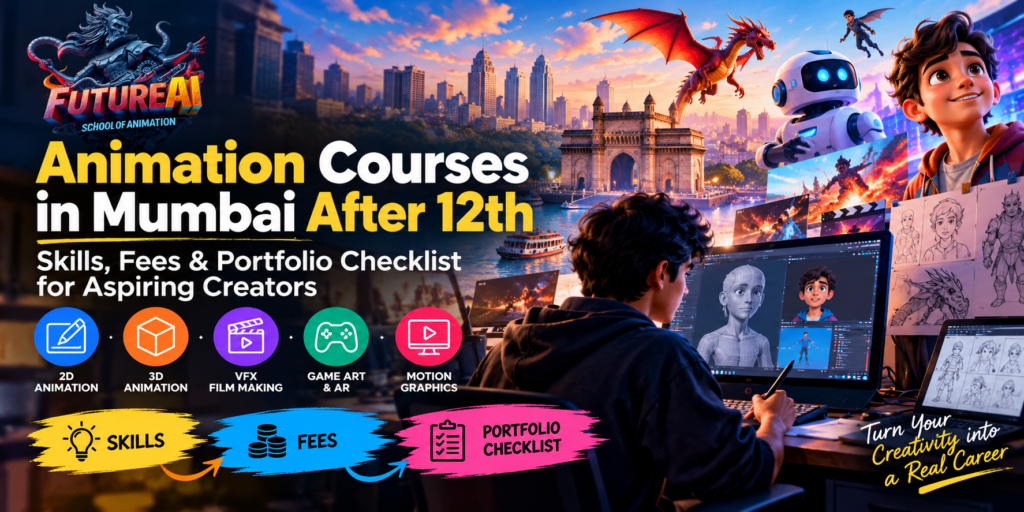
Future AI: Animation Courses in Mumbai After 12th – Skills, Fees & Portfolio Checklist for Aspiring Creators
By Digital Arpita Mishra | Digital Marketing Blogger
Choosing a career after completing the 12th standard can feel exciting and confusing at the same time. Students today have opportunities beyond traditional career paths, especially in creative and technology-driven industries. Animation, visual effects (VFX), gaming, motion graphics, and digital design are some of the fields attracting students who enjoy creativity, storytelling, and technology.
Mumbai is an important destination for students exploring creative education. With its connection to film, television, advertising, media, and digital content production, the city offers an environment in which aspiring creators can explore different career possibilities.
However, choosing an animation course is not simply about selecting an institute. Students should understand the skills they want to develop, the type of work they enjoy, the course curriculum, the fees, and the portfolio they will need to build.
This guide explains what students should know about animation courses in Mumbai after 12th, including different specialisations, career opportunities, essential skills, course fee considerations, portfolio development, and how to evaluate an institute.
It also introduces Future AI Animation School as one of the institutes students can explore while researching creative education options.
Understanding Animation Courses After 12th
Animation is the process of creating the illusion of movement by displaying a sequence of images, drawings, or digitally generated frames. It is used in films, television, advertisements, games, educational content, digital media, and many other industries.
Modern animation combines artistic creativity with technical knowledge. Depending on the specialisation, students may learn drawing, character design, 3D modelling, animation, lighting, rendering, compositing, or game development.
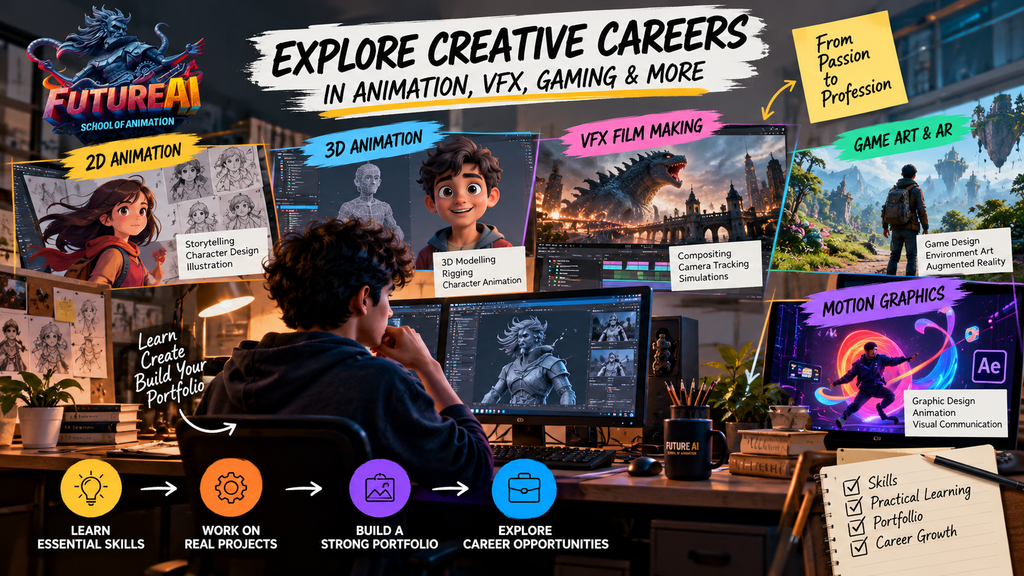
Before selecting a course, it is helpful to understand the main areas of animation and related creative fields.
1. 2D Animation
2D animation creates movement in a two-dimensional space. Characters and objects are designed using height and width, and their movements are created through drawings or digital animation techniques.
It is used in cartoons, explainer videos, advertisements, educational content, and short films.
Students interested in drawing, illustration, character expressions, and storytelling may enjoy exploring 2D animation.
Common learning areas include:
- Character design
- Storyboarding
- Basic drawing and illustration
- Timing and spacing
- Character movement
- Scene composition
2. 3D Animation
3D animation involves creating and animating objects, characters, and environments in a three-dimensional digital space.
It is widely used in animated films, visual effects, games, advertisements, product visualisation, and digital experiences.
Students may learn:
- 3D modelling
- Texturing
- Rigging
- Character animation
- Lighting
- Rendering
- Environment creation
3D animation combines visual design with technical workflows. Students interested in building digital worlds and bringing characters to life may find this field engaging.
3. Visual Effects (VFX)
Visual effects are used to create or enhance images that may be difficult, expensive, or impossible to capture directly during filming.
VFX can include creating digital environments, adding explosions, removing unwanted objects, combining footage, and integrating computer-generated elements with live-action scenes.
Important learning areas may include:
- Compositing
- Camera tracking
- Rotoscoping
- Matte painting
- Particle effects
- Simulation
- Post-production
Students interested in films, visual problem-solving, and technical creativity may explore VFX as a specialisation.
4. Game Art and Game Development
The gaming industry combines visual design, animation, programming, sound, and interactive experiences.
Game artists may create characters, environments, props, textures, and other visual assets. Game developers work with programming and game engines to build interactive experiences.
Students interested in gaming may explore topics such as:
- 3D modelling for games
- Game environment design
- Character design
- Game engines
- Basic programming
- Interactive design
- Augmented reality (AR)
The exact subjects depend on the course and its specialisation.
5. Motion Graphics
Motion graphics combine graphic design with movement. They are commonly used in advertisements, title sequences, social media videos, presentations, broadcast graphics, and promotional content.
Students interested in typography, visual communication, design, and video content may find motion graphics a suitable area to explore.
Learning areas can include:
- Graphic design fundamentals
- Typography
- Composition
- Animation principles
- Transitions
- Colour theory
- Motion design
Understanding these specialisations can help students choose a course that matches their interests instead of selecting a programme only because it sounds popular.
Career Opportunities After an Animation Course
Animation and related creative fields offer different career paths. The role a student pursues will depend on their skills, specialisation, portfolio, experience, and the requirements of employers.
Here are some roles students may explore.
2D Animator
A 2D animator creates movement for characters, objects, and scenes. The work may involve character actions, facial expressions, and storytelling through movement.
3D Animator
A 3D animator creates movement for digitally modelled characters and objects. The role may involve character animation, object animation, or scene-based animation.
Character Designer
Character designers develop the visual appearance of characters. They may work on shapes, proportions, expressions, costumes, and visual personality.
3D Modeller
A 3D modeller creates digital objects, characters, props, and environments. Modelling skills are used in animation, games, VFX, and product visualisation.
VFX Artist
A VFX artist works on visual effects for films, advertisements, television, and digital media. Depending on the specialisation, the work may include compositing, tracking, simulations, or digital environment creation.
Motion Graphics Designer
A motion graphics designer creates animated graphic elements for advertisements, videos, presentations, and digital platforms.
Game Artist
A game artist creates visual assets used in games. These may include characters, props, environments, textures, and other digital elements.
Lighting Artist
A lighting artist works with lighting in digital scenes to establish mood, depth, and visual clarity.
Environment Artist
An environment artist creates digital spaces such as landscapes, buildings, rooms, and other environments used in films, animation, or games.
These roles can have different skill requirements. Students should explore the work associated with each career and understand which skills they need to develop.
Essential Skills for Aspiring Animators
Students do not need to be professional artists before joining an animation course. However, developing a few foundational skills can make the learning process easier.
Creative Thinking and Storytelling
Animation is a visual storytelling medium. A character’s movement, a scene’s composition, and the timing of an action can communicate emotions and ideas.
Students should practise observing stories in films, advertisements, games, and everyday life.
Drawing and Observation
Drawing can help students understand shapes, proportions, expressions, and movement.
Even students interested in 3D animation can benefit from basic drawing and observation skills. These abilities can help them understand how objects and characters are structured.
Understanding Animation Principles
Animation involves more than moving an object from one position to another. Movement should communicate weight, timing, and intention.
Some important principles include:
- Timing and spacing
- Squash and stretch
- Anticipation
- Follow-through
- Overlapping action
- Ease in and ease out
- Arcs
- Staging
These principles help make animation feel more natural and expressive.
Technical Skills
Different animation specialisations use different software and workflows.
Students may explore tools used for 2D animation, 3D modelling, compositing, motion graphics, or game development. The specific software depends on the programme and industry workflow.
Learning software is important, but students should also understand the creative concepts behind the tools.
Patience and Problem-Solving
Creative projects often require repeated adjustments. A model may need refinement, an animation may feel unnatural, or a VFX shot may require multiple revisions.
Patience, attention to detail, and the ability to solve problems are valuable skills for aspiring creators.
Why Practical Learning and Portfolio Development Matter
Animation is a skill-based field. Understanding concepts is important, but students also need opportunities to apply those concepts through practical projects.
A portfolio is a collection of selected work that demonstrates a student’s abilities. It can help employers, clients, or collaborators understand what the student can create.
A useful portfolio should show the student’s strongest work and reflect their chosen specialisation.
What Should an Animation Portfolio Include?
The portfolio depends on the student’s interests.
A 2D animation portfolio may include character designs, storyboards, and short animation exercises.
A 3D animation portfolio may include models, character animation, lighting studies, and rendered scenes.
A VFX portfolio may include compositing shots, tracking work, simulations, or before-and-after breakdowns.
A game art portfolio may include characters, props, environments, textures, and game-ready assets.
Portfolio Tips for Beginners
Students can begin with small projects and gradually improve their work.
- Choose a specialisation: Decide whether you are more interested in animation, VFX, game art, or motion graphics.
- Start with manageable projects: Avoid beginning with a complicated film or game.
- Show your process: Include relevant sketches, breakdowns, or stages of development.
- Focus on quality: A few well-developed projects can be more effective than many unfinished projects.
- Improve through feedback: Review your work and make changes based on constructive feedback.
- Keep practising: A portfolio should reflect progress and continued learning.
Students should remember that their portfolio is not only a collection of completed assignments. It is an opportunity to demonstrate creativity, problem-solving, and practical skills.
Exploring Future AI Animation School
Students researching animation courses in Mumbai can also explore Future AI Animation School and review the programmes it lists.
The school’s programme information includes areas such as animation, VFX filmmaking, broadcast design, gaming with AR, and other creative and digital fields.
The following descriptions reflect the programme areas discussed in the school’s listed course information. Students should confirm the latest curriculum, duration, fees, eligibility, and availability directly with the institute.
Animation Prime Modules
The Animation Prime programme is listed with an approximate duration of 18 months.
The subjects described include areas such as:
- Graphic concepts
- Digital illustration
- 3D modelling
- Character animation
- Rigging
- Rendering
- Effects
Students interested in developing a foundation in animation and 3D workflows may want to review the detailed syllabus and practical project structure.
VFX Film Making
The VFX Film Making programme is listed with an approximate duration of 18 months.
The programme areas described include:
- Visual effects
- Compositing
- Camera tracking
- Post-production
- Simulations
Students interested in film-based visual effects should examine how the course combines technical training with practical shot work.
Broadcast Prime
The Broadcast Prime programme is listed with an approximate duration of one year.
The listed subject areas include:
- 2D animation
- Motion graphics
- Colour correction
- Broadcast design
- Post-production
This programme area may be relevant to students interested in broadcast graphics, video content, and motion design.
Advance Gaming Course with AR
The Advance Gaming Course with AR is listed with an approximate duration of 12 months.
The programme areas described include:
- Unity 3D
- C#
- Visual design
- AR tracking
- Mobile deployment
Students interested in interactive experiences and game development can review the course details to understand how these subjects are taught and how much practical project work is included.
Future AI’s website also lists other areas such as web design, UI/UX, and specialised dynamics. Students should check the official website for the latest programme information.
Official website: https://future-ai.in/
When evaluating any institute, students should compare the curriculum, practical work, faculty guidance, facilities, fees, and portfolio support. Programme names alone are not enough to determine whether a course is suitable.
Animation Course Fees in Mumbai: What Should Students After 12th Consider?
One of the most common questions students ask while exploring animation courses in Mumbai after 12th is, “How much will the course cost?”
The answer depends on several factors, including the course duration, specialisation, software training, practical facilities, and the institute’s curriculum. A short-term course in 2D animation may have a different fee structure from an advanced programme covering 3D animation, character rigging, VFX, or game development.
It is important to remember that the lowest fee does not always mean the best value, and the highest fee does not automatically guarantee better training. Students should understand exactly what is included before making a decision.
Factors That Can Affect Animation Course Fees
When comparing institutes, consider the following:
- Course duration: Longer programmes may include more subjects and practical projects.
- Specialisation: Advanced 3D animation, VFX, game development, and AR-related training may involve different learning requirements.
- Software training: Check which software applications are included in the curriculum.
- Practical facilities: Find out whether students receive access to computer labs, rendering facilities, and project-based learning.
- Portfolio development: A programme that includes structured portfolio projects may offer additional value.
- Certification: Ask whether a certificate is provided and who issues it.
- Payment options: Understand whether the institute offers instalments and what the payment schedule looks like.
Students should request the latest official fee details directly from the institute. Fees, course structures, and available payment options can change, so it is better not to rely on old advertisements or unofficial online information.
Questions to Ask Before Paying Course Fees
Before enrolling in an animation institute, ask for a complete fee breakdown.
- What is the total course fee?
- Are registration and admission charges included?
- Are software, lab, or rendering charges additional?
- Are examination and certificate fees included?
- Is the fee payable in instalments?
- What is the refund or cancellation policy?
- Will students receive practical project assignments?
- Is portfolio development part of the programme?
A clear understanding of these details can help students and parents make a more informed decision.
Checklist for Choosing an Animation Institute in Mumbai
Choosing an institute is an important step in an aspiring creator’s career. Students should compare institutes based on learning quality, curriculum, practical exposure, and career preparation rather than relying only on advertisements.
Use this checklist while evaluating an animation school.
1. Check the Course Curriculum
The curriculum should match your career interest.
For example, a student interested in 3D character animation should look for topics such as modelling, rigging, character movement, lighting, and rendering. Someone interested in VFX should explore compositing, tracking, simulation, and post-production.
Ask for the detailed syllabus instead of relying only on the course title.
2. Understand the Practical Learning Structure
Animation is a skill-based field. Students need opportunities to practise what they learn.
Ask whether the programme includes:
- Regular assignments
- Practical demonstrations
- Individual projects
- Feedback from instructors
- Final portfolio projects
A course should help students gradually move from basic exercises to more advanced creative work.
3. Review Student Projects and Portfolios
A portfolio can provide useful insight into the type of work students are learning to create.
If an institute shares student projects, look at them carefully. Consider whether the work demonstrates different skills, such as modelling, animation, compositing, visual design, or storytelling.
Do not judge an institute only by a few highly polished promotional examples. Ask about the learning process behind the projects.
4. Ask About Faculty and Mentorship
Students should understand who will teach the course and how feedback is provided.
Useful questions include:
- Who teaches the major subjects?
- How frequently do students receive feedback?
- Are doubts addressed during practical sessions?
- Can students receive guidance on their portfolio?
- Is there a process for reviewing completed projects?
Consistent feedback can help students identify mistakes and improve their work.
5. Understand Career Support
Some institutes may provide career guidance, portfolio reviews, interview preparation, or placement assistance. However, students should understand what these services actually include.
Ask for clear information about:
- Resume and portfolio support
- Interview preparation
- Internship opportunities
- Employer connections
- Placement assistance terms
- Any published placement data and how it was collected
Placement assistance should not be interpreted as a guaranteed job. Students should ask for written details and understand the conditions attached to any career-support service.
6. Compare the Overall Learning Experience
Before making a final decision, compare the course duration, syllabus, practical work, fee structure, facilities, and career guidance offered by different institutes.
The right choice is the one that fits your interests, learning needs, budget, and long-term goals.
How to Prepare for an Animation Course After 12th
Students do not need to wait until their course begins to start developing creative skills. A few simple habits can help them build confidence and understand the field better.
Start Observing the World Around You
Animation is connected to movement, expressions, shapes, and storytelling.
Observe how people walk, how objects move, how light falls on surfaces, and how facial expressions change. These observations can help students understand movement and visual design.
For example, try observing the difference between the movement of a heavy object and a lightweight object. Such small observations can later help when creating animation.
Practise Basic Drawing and Design
Drawing can help students understand shapes, proportions, poses, and composition.
Start with simple exercises:
- Draw basic geometric shapes.
- Sketch everyday objects.
- Practise facial expressions.
- Draw simple character poses.
- Study the proportions of different objects.
Students interested in 3D animation or VFX should not assume that drawing is the only important skill. Observation, problem-solving, technical understanding, and creativity are also valuable.
Explore Creative Software
Students can explore introductory tutorials for software used in animation, design, or VFX.
The goal should not be to master every application before joining a course. Instead, try to understand the basic workflow and discover which creative area feels interesting.
For example, a student may enjoy designing a character more than editing a video. Another student may enjoy building a 3D environment or creating visual effects.
Exploring these areas can help students make a more informed course decision.
Build Small Projects
A beginner portfolio does not need to contain complicated projects.
Start with manageable ideas such as:
- A simple bouncing-ball animation
- A short character walk cycle
- A basic 3D object model
- A small motion graphics title
- A simple visual effects experiment
- A game environment concept
The purpose is to practise consistently and document improvement over time.
Keep Learning from References
Students can learn by observing animation films, advertisements, games, short films, and online tutorials.
When studying a reference, ask:
- How is the scene composed?
- What makes the movement feel natural?
- How does lighting affect the mood?
- How are colours used?
- What makes the visual story understandable?
Learning to analyse creative work can improve both technical and artistic thinking.
Common Mistakes Students Should Avoid
While choosing animation courses in Mumbai after 12th, students should be careful about a few common mistakes.
Choosing a Course Only Because It Is Popular
A popular course may not necessarily match your interests. Before enrolling, understand the subjects and the kind of projects you will create.
Assuming Drawing Is the Only Requirement
Drawing is useful, particularly for illustration and character design, but animation and VFX also require technical knowledge, observation, patience, and problem-solving.
Selecting an Institute Only by Fee
A low fee may look attractive, but students should compare the complete curriculum, practical facilities, and learning support. Similarly, a high fee should be evaluated against the actual training offered.
Ignoring Portfolio Development
A certificate can document course completion, but creative work demonstrates skills. Students should make portfolio development a regular part of their learning journey.
Expecting Immediate Career Results
Animation skills take time to develop. Students should focus on consistent practice, feedback, and project quality rather than expecting instant results after completing a course.
Not Reading the Course Terms
Before paying fees, read the admission terms, refund policy, course duration, certificate details, and any career-support conditions carefully.
Frequently Asked Questions About Animation Courses in Mumbai After 12th
1. Can I join an animation course after completing 12th?
Yes. Students can explore animation, 3D animation, VFX, game art, and related creative programmes after completing their 12th standard. The eligibility requirements may differ between institutes and courses, so students should confirm the current admission criteria.
2. Do I need drawing skills to learn animation?
Basic drawing and observation skills can be helpful, especially for 2D animation, illustration, and character design. However, students can also explore 3D animation, VFX, motion graphics, and game development, where technical and problem-solving skills are important.
A beginner does not need to be an expert artist before starting a course.
3. How long does an animation course take?
Course duration depends on the programme and its level of specialisation. Some courses are short-term, while advanced programmes may take a year or longer.
Students should check the current course duration, class schedule, and practical training structure directly with the institute.
4. What is the fee for animation courses in Mumbai?
There is no single fee for all animation courses. The cost depends on the institute, course duration, curriculum, software training, and facilities.
Students should request the latest official fee structure and confirm whether additional charges apply.
5. What career options are available after an animation course?
Depending on their skills and specialisation, students may explore roles such as:
- 2D Animator
- 3D Animator
- Character Designer
- 3D Modeller
- VFX Artist
- Compositing Artist
- Motion Graphics Designer
- Game Artist
- Lighting Artist
- Environment Artist
Career opportunities depend on portfolio quality, practical skills, experience, and the requirements of employers.
6. What should I include in an animation portfolio?
A portfolio should include selected projects that demonstrate your strongest skills. Depending on your specialisation, this may include animation exercises, character designs, 3D models, VFX shots, motion graphics, or game assets.
It is better to show a few well-developed projects than to include many unfinished or unrelated pieces.
7. What courses does Future AI Animation School offer?
Future AI Animation School lists programmes related to animation, VFX filmmaking, broadcast design, gaming with AR, and other creative and digital fields. The available programmes, curriculum, duration, and admission requirements should be verified directly with the school because details may change.
Students can explore the official website at https://future-ai.in/ for current information.
Final Thoughts: Start Your Creative Journey with the Right Skills
Choosing an animation course after 12th is not only about selecting a college or paying course fees. It is about understanding your creative interests, developing practical skills, and building a portfolio that reflects your progress.
Mumbai offers opportunities for students interested in animation, VFX, gaming, motion graphics, and digital content creation. However, the quality of your learning journey will depend on how consistently you practise, how well you understand your chosen specialisation, and how effectively you develop your creative work.
Before enrolling in any institute, compare the curriculum, course duration, fee structure, practical training, faculty guidance, and portfolio support. Ask questions, review the course details, and make a decision that aligns with your goals.
For students exploring animation and related creative programmes, Future AI Animation School can be one of the institutes to research and compare. Visit the official website to review its current programmes and request updated admission and fee information.
Your journey as a creator can begin with a simple idea. With regular practice, curiosity, and the right learning environment, that idea can gradually develop into a meaningful creative skill.
About the Author
Digital Arpita Mishra is a digital marketing blogger who writes about creative education, digital skills, and career opportunities for aspiring creators. Her content aims to help students explore learning options and make informed decisions about their future.
This article is intended for educational and informational purposes. Course availability, fees, eligibility, and programme details may change. Students should verify the latest information directly with the institute before making an admission decision.