
Introduction
Search is no longer limited to typing queries into Google and clicking links. Over the past few years, the way people discover information online has evolved significantly. Today, users are just as likely to ask questions directly to AI tools like ChatGPT, Gemini, or Perplexity as they are to search on traditional engines.
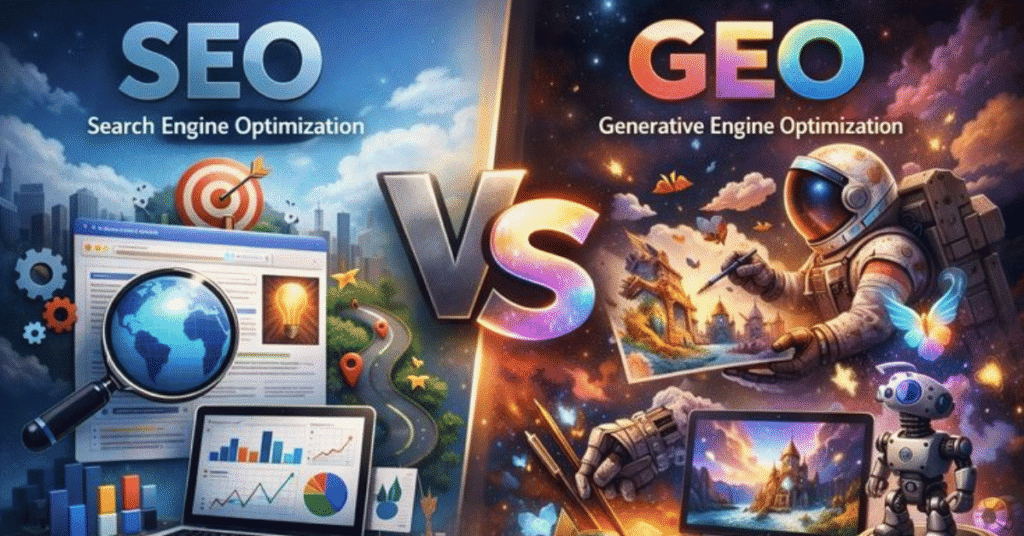
This shift has introduced a new concept in digital marketing: Generative Engine Optimization (GEO). While Search Engine Optimization (SEO) has long been the foundation of online visibility, GEO focuses on optimizing content for AI-generated answers rather than search rankings.
This evolution has created confusion among marketers, founders, and content creators. Questions like “What is GEO in digital marketing?”, “Is SEO dead in 2026?”, and “Which strategy is better—GEO vs SEO?” are becoming increasingly common.
Understanding this shift is crucial. In 2026, visibility is no longer just about ranking—it’s about being present wherever users search, whether that’s Google or AI.
What is SEO (Search Engine Optimization)?
Definition
Search Engine Optimization (SEO) is the process of improving a website’s visibility on search engines like Google by optimizing content, structure, and authority signals to rank higher in organic results.
How SEO Works
SEO works by aligning your content with what users are searching for. Search engines analyze:
- Relevance
- Content quality
- Website authority
- User experience
The better your content satisfies these factors, the higher it ranks.
Types of SEO
🔹 On-Page SEO
- Keyword optimization
- Content quality
- Internal linking
🔹 Off-Page SEO
- Backlinks
- Brand mentions
🔹 Technical SEO
- Site speed
- Mobile optimization
- Crawlability
Why SEO Still Matters
- Drives consistent organic traffic
- Builds long-term brand authority
- Helps users discover your content
SEO remains the backbone of digital marketing—but it is evolving.
What is GEO (Generative Engine Optimization)?
Definition
Generative Engine Optimization (GEO) is the process of optimizing content to appear in AI-generated responses from platforms like ChatGPT, Gemini, and Perplexity.
How AI Search Works
AI tools:
- Understand queries conversationally
- Combine multiple sources
- Deliver direct answers
Unlike Google, users often don’t click links—they consume answers instantly.
How Content Appears in AI Responses
AI prioritizes content that is:
- Clear
- Well-structured
- Context-rich
- Trustworthy
Why GEO Matters in 2026
- AI usage is increasing
- Zero-click searches are rising
- Visibility depends on being referenced
Key Differences: GEO vs SEO
| Factor | SEO | GEO |
|---|---|---|
| Platform | AI tools | |
| Goal | Ranking | AI visibility |
| Strategy | Keywords | Context + authority |
| Content Style | Structured | Conversational |
| Traffic | Click-based | Answer-based |
Similarities Between SEO and GEO
- Content quality is critical
- Authority (EEAT) matters
- User intent drives success
- Optimization is required
SEO vs GEO: Which is Better?
There is no single winner.
👉 SEO is best for:
- Long-term traffic
- Website growth
👉 GEO is best for:
- AI visibility
- Future-proof branding
👉 Best Approach:
👉 Use both together
Real-World Example: SEO vs GEO
Scenario: “Best Digital Marketing Strategies”
SEO:
- User clicks blog
- Website gets traffic
GEO:
- AI gives direct answer
- No click needed
🔥 Insight:
👉 SEO = Traffic
👉 GEO = Visibility
The Rise of Zero-Click Searches
What It Means:
Users get answers without clicking links.
Impact:
- Less website traffic
- More importance on authority
- Content must be reference-worthy
Content Strategy Shift: Keywords → Context
Old SEO:
- Focus on keywords
New SEO + GEO:
- Focus on solving problems
- Provide deep, meaningful answers
How AI Selects Content
AI looks for:
- Clarity
- Depth
- Structure
- Authority
- Trust
Advanced GEO Optimization Techniques
🚀 Answer-first writing
Start with direct answers
🚀 Semantic depth
Cover topics completely
🚀 Conversational tone
Write like you speak
🚀 Structured formatting
Use headings, bullets, FAQs
SEO Isn’t Dead — It’s Evolving
| Old SEO | New SEO |
|---|---|
| Keyword stuffing | Intent-based content |
| Ranking focus | User experience |
| Backlinks only | Authority + relevance |
Role of Personal Branding
AI prefers:
- Recognized experts
- Trusted voices
👉 Build authority by:
- Publishing consistently
- Sharing insights
- Building niche expertise
Common Mistakes to Avoid
❌ Ignoring AI search
❌ Overusing keywords
❌ Weak content
❌ No updates
Hybrid Strategy (Step-by-Step)
- Keyword + intent research
- Create pillar content
- Add FAQs
- Optimize readability
- Build authority
- Update regularly
GEO vs SEO for Different Users
👨💼 Businesses
SEO → Traffic
GEO → Visibility
👨💻 Freelancers
SEO → Portfolio
GEO → Authority
🎓 Students
Learn both
Future of Search (2026 & Beyond)
🚀 AI + Search Integration
Search engines are evolving
📉 Zero-click growth
Less clicks, more answers
🏆 Brand authority matters
Strong brands win
Conclusion
The debate around SEO vs GEO is not about choosing one—it’s about understanding both.
SEO helps you rank.
GEO helps you get referenced.
The future belongs to those who combine both.