
Best SEO Tools in 2026 (Compared & Reviewed)
Introduction
Getting organic search traffic to your website has changed radically over the last few years. The old playbooks—like writing a basic text post and throwing a few keywords in the titles—simply do not work anymore.
Today, search engines are smart. Between traditional blue links, Google’s dynamic AI Overviews, and conversational engines like Perplexity or ChatGPT search, outranking your competition requires real data. You cannot rely on guesswork to find the keywords your target market is searching for.
Whether you are an absolute beginner launching your first website, a content creator growing a digital footprint, a YouTuber diversifying into blogging, or a small business owner cutting through local competition, the right software is vital. The problem is that the digital market is overflowing with complicated platforms that promise immediate rankings but deliver confusing interfaces and bloated pricing.
To make things easy for you, I have spent the last few weeks testing the world’s most prominent search engine optimization platforms. I built live projects, ran multi-page technical SEO audits, checked backlink fresh rates, and monitored rank tracking software across multiple physical locations.
This extensive guide reviews the 5 best SEO tools available in 2026. We will dive into their actual features, honestly examine their advantages and limitations, and pinpoint exactly which system will maximize your organic performance.
Why This Topic Matters in 2026: Navigating AI Overviews & Traditional Search
The search ecosystem in 2026 is highly fragmented. We are no longer optimizing purely for a static desktop index. Instead, search engine optimization platforms must provide a holistic visual report across a complex search landscape:
- AI Search Visibility & Citations: Winning traffic today requires tracking whether your site is used as a cited resource inside Google AI Overviews, Gemini, Perplexity, and OpenAI search modules.
- Hyper-Localized Intent: A business page ranking #3 in one city might rank #12 just three miles away. Advanced geo-targeting down to specific zip codes has become a standard requirement for local SEO software.
- Intent-Based Keyword Clustering: Search engines group keywords by search intent automatically using natural language processing (NLP). If your keyword research software doesn’t group related phrases together, your content won’t build deep topical authority.
- Agentic Integrations: The latest modern tools offer direct connections via Model Context Protocol (MCP) servers or APIs, letting custom AI agents query real-world ranking metrics dynamically.
Quick Comparison Table
| Tool Name | Best For | Keyword Database | Track AI Overviews? | Starting Price | Free Tier / Trial |
| Semrush One | Best All-in-One Platform & Competitor Data | Massive (26B+ Keywords) | Yes (Deep Tracking) | $139.95/mo | Limited Free Account |
| Ahrefs | Best for Backlinks & Technical Link Builders | Exceptionally Large | Yes (Connects to LLMs) | $129.00/mo | Limited Tools |
| SE Ranking | Best Balance for Agencies & Budgets | Large & Fast-Growing | Yes (Full GEO + AI Tracking) | $65.00/mo | 14-Day Free Trial |
| Nightwatch | Best High-Accuracy Geo-Rank Tracking | Specialized | Yes (AI Visibility Tracking) | $39.00/mo | 14-Day Free Trial |
| Search Atlas | Best Modern AI Content Optimization | Large | Yes (Tracks ChatGPT & Gemini) | $99.00/mo | 7-Day Free Trial |
Detailed Product Reviews
1. Semrush One
The Undisputed King of Competitive Intelligence and Multi-Channel Data
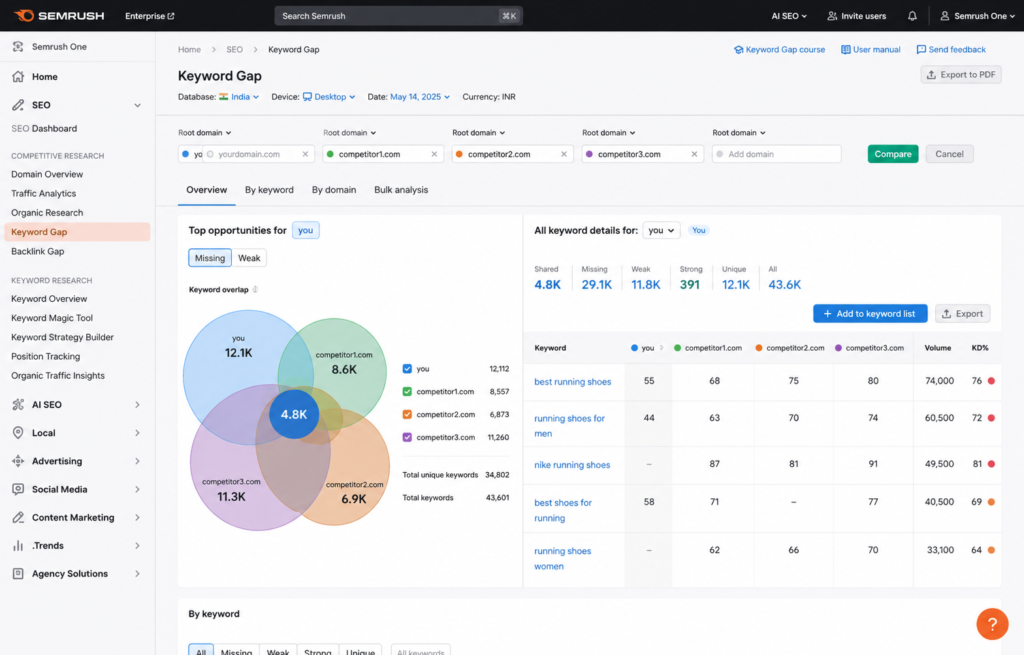
Semrush One is a comprehensive platform for search engine optimization. Used by millions of digital marketers worldwide, it functions as a comprehensive dashboard that handles everything from daily site health tracking to deep competitor ads intelligence.Overview
Semrush One earned its top reputation by building a massive keyword database (housing over 26 billion search terms) and pairing it with a powerful competitive intelligence toolkit. If you need to know exactly what keywords your competitors are buying, what copy they are testing, and what content drives their highest organic search traffic, Semrush One provides the clearest data.
Key Features
- Keyword Magic Tool: Generates thousands of long-tail variations grouped into organized topical clusters with search intent indicators.
- Comprehensive Technical SEO Audit: Crawls your platform to check for Core Web Vitals, broken code structure, and duplicate layout sections.
- AI ContentShake Integration: Builds optimized SEO content briefs and outline drafts based directly on your live target keyword statistics.
- MCP Server Integration: Allows developers to let customized AI workflows extract search volume and ranking metrics safely via backend setups.
Pros & Cons
Pros:
- Outstanding competitor research capabilities across both organic search and paid Google Ads.
- Comprehensive tracking suites mean you rarely need to pay for secondary tracking software.
- Local SEO software add-ons allow you to sync information directly with Google Maps listing dashboards.
Cons:
- The entry-level plan limits you to 5 active projects, which can feel restrictive for growing agencies.
- The crowded user interface can feel intimidating for absolute beginners during their first week.
- Pricing: Plans start at $139.95/month for the Pro tier, rising to $249.95/month for Guru and $499.95/month for Enterprise setups. (Annual billing discounts reduce rates significantly).
- Best For: Content creators, digital marketing teams, and growth managers who want one unified platform to handle all aspects of web search optimization.
- My Recommendation: If you have the budget and need a tool that covers every angle of your competitor’s marketing playbook, Semrush One is the clear industry leader.
- Overall Rating: ⭐⭐⭐⭐⭐ (4.9 / 5)
2. Ahrefs
The Backlink Analysis Benchmark for Advanced Growth and Link Professionals
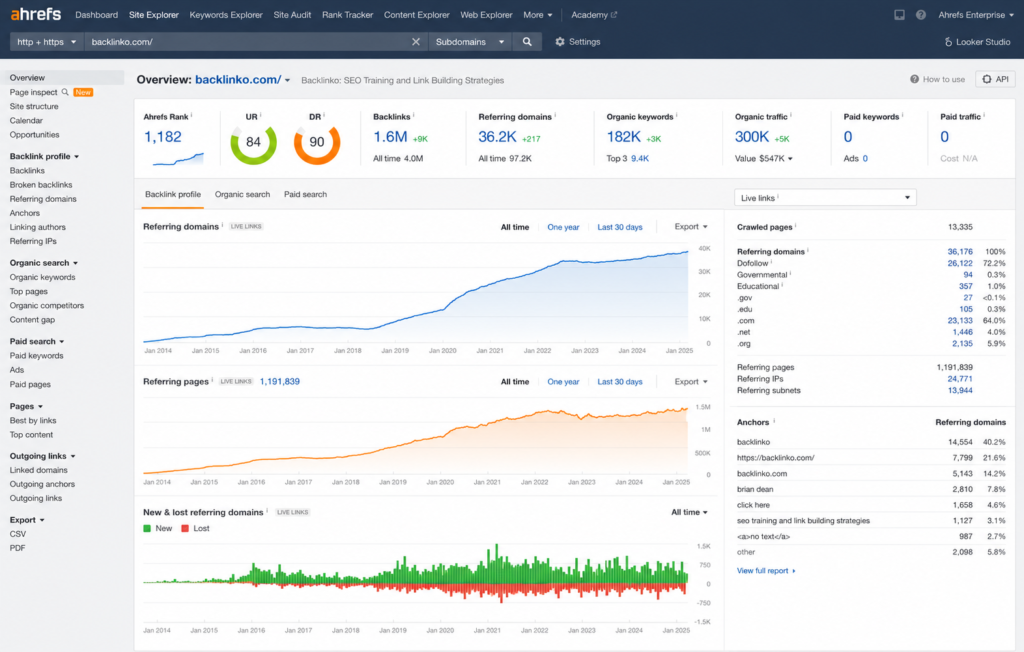
Ahrefs approaches search engine visibility through the lens of authority. It is widely considered the gold standard for backlink analysis tools due to its rapid web crawler speeds and unmatched database integrity.Overview
While other platforms specialize in broad marketing tools, Ahrefs focuses heavily on link building, tracking domain authority, and locating backlink gaps. Its interface makes it simple to view the precise source of every link your competitor points to, analyze their anchor text distribution, and uncover high-value link-building opportunities.
Key Features
- Industry-Leading Site Explorer: Displays clean historical authority profiling with index updates occurring every 15 minutes.
- Custom Content Gap Analysis: Uncovers the precise search phrases multiple industry competitors rank for that your site is missing.
- Advanced Keyword Clustering: Groups extensive target keywords by natural search intent to prevent keyword cannibalization issues.
- LLM Data Connectors: Integrates with tools like Claude Pro or custom agent networks to analyze ranking structures programmatically.
Pros & Cons
Pros:
- The most accurate and largest live backlink index available in the industry.
- Extremely clean, intuitive user experience that visualizes metrics effectively.
- Historical ranking charts make it easy to see how algorithm changes affected past traffic trends.
Cons:
- Relies on a pay-per-seat model, meaning costs climb quickly if you need to add team members.
- Entry-level plans do not include full access to historical search data.
- Pricing: Entry-level Lite starts at $129/month, scaling to the Standard plan at $249/month and Advanced tiers at $449+/month.
- Best For: Dedicated link builders, SEO professionals, agencies, and content creators running active outreach and digital PR campaigns.
- My Recommendation: If your digital strategy depends on building a powerful backlink profile and outperforming high-authority competitors, Ahrefs is an essential investment.
- Overall Rating: ⭐⭐⭐⭐½ (4.8 / 5)
3. SE Ranking (Omni Suite)
The Best Comprehensive Alternative for Scaling Agencies and Growing Teams
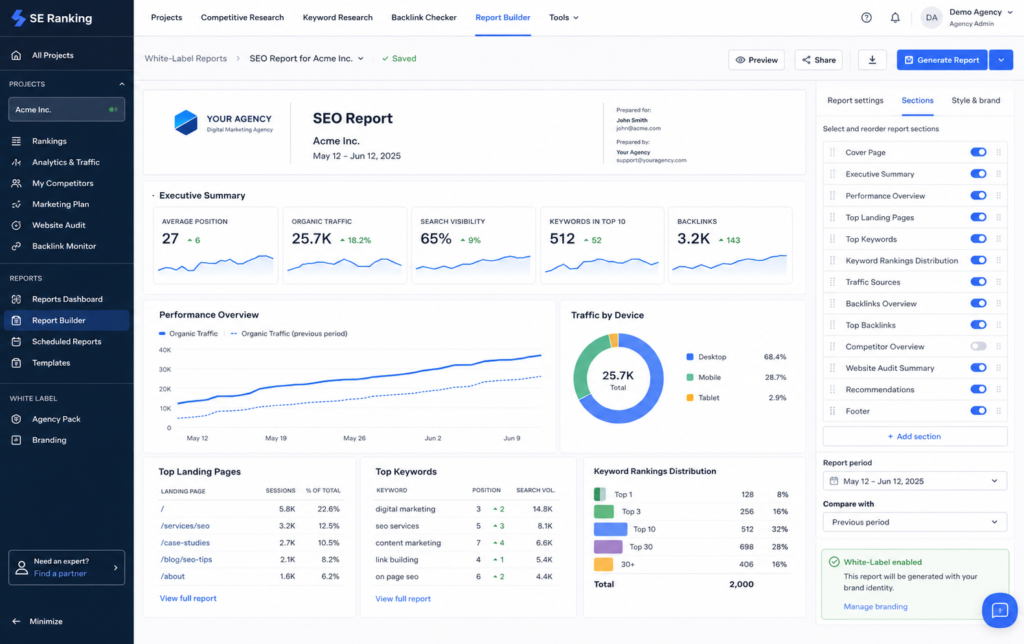
SE Ranking has established itself as a top-tier all-in-one suite. It provides a full set of keyword, technical, and local marketing tools at a highly competitive price point.Overview
SE Ranking offers a compelling mix of features: it matches the core utility of enterprise platforms while keeping its subscription plans within reach for freelance consultants and growing agencies. It provides daily rank tracking, localized tracking metrics, and fully customizable white-label client reports without hidden cost multipliers.
Key Features
- Daily Position Tracking: Monitors your keyword placements daily across Google, mobile devices, and alternative search platforms like Bing.
- AI Overview & Geo-Tracking Module: Identifies whether your brand’s pages appear within regional Google AI Overviews or traditional local packs.
- Deep Page Changes Monitor: Automatically alerts your team if a client or competitor adjusts headers, meta values, or page content layouts.
- Generous White-Label Customization: Build professional, automated, and branded performance reports for your clients.
Pros & Cons
Pros:
- Outstanding value for money with high data limits on all plans.
- Daily rank updates come standard, unlike competitors that charge extra for frequent data refreshes.
- Clean, beginner-friendly interface that reduces training time for new teams.
Cons:
- Global backlink database, while reliable, updates slightly slower than Ahrefs.
- Competitive traffic estimates are sometimes less detailed for small niche industries compared to Semrush.
- Pricing: Paid tiers start affordably at $65/month (Essential), stepping up to Pro ($149/month) and Business ($299/month) settings. (Substantial discounts apply for annual billing structures).
- Best For: Mid-sized marketing agencies, busy digital freelancers, and small business owners who want an all-in-one toolkit that leaves room in the budget.
- My Recommendation: If you need to manage multiple sites, require fresh daily data, and want to send clean reports to clients without paying enterprise premiums, SE Ranking is the smartest choice on the market.
- Overall Rating: ⭐⭐⭐⭐½ (4.7 / 5)
4. Nightwatch
The High-Precision Rank Tracker Built for Local Domination and Large-Scale Location Monitoring
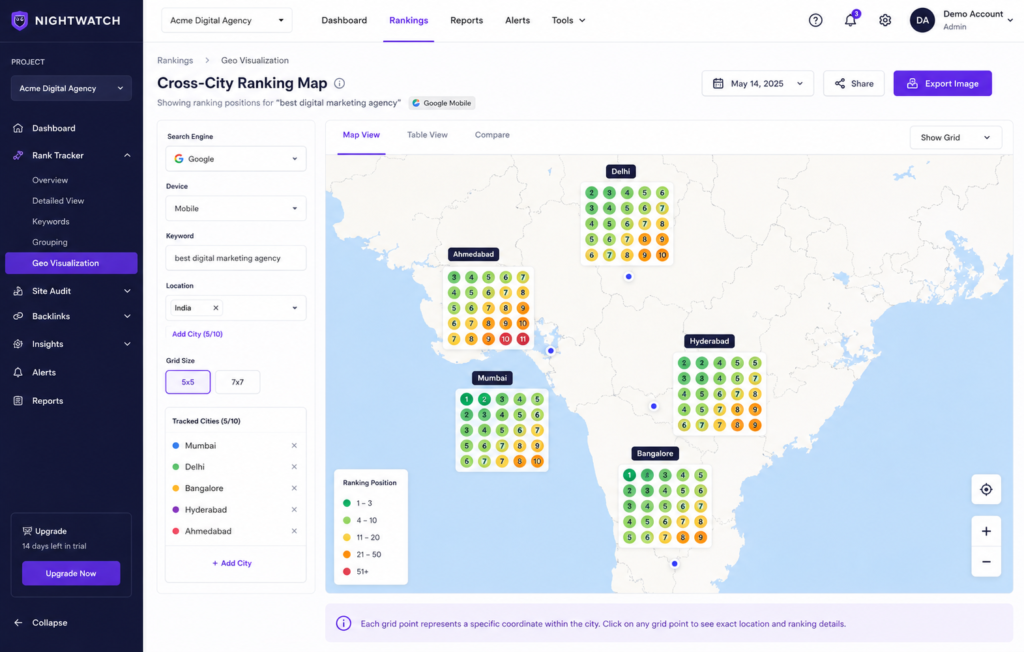
If your primary objective is tracking your organic positions down to specific cities, neighborhoods, or local coordinate points, Nightwatch provides unmatched precision.Overview
Most general tools estimate keyword positions across a broad national average, which can leave blind spots for local businesses. Nightwatch approaches rank tracking software by tapping into more than 100,000 localized search nodes around the world. This makes it a great choice for verifying exactly what your prospective customers see in real-time.
Key Features
- Hyper-Targeted Localized Tracking: Monitors your organic positions across precise zip codes, neighborhoods, and custom regional viewports.
- AI Search Visibility Analytics: Gauges your overall brand impact across both classic search layouts and new automated response blocks.
- Dynamic Smart Columns: Customizes and filters massive lists of keywords by volume, difficulty, layout features, or tag groups instantly.
- Affordable High-Volume Scans: Track thousands of long-tail phrases across various platforms without hitting expensive pricing walls.
Pros & Cons
Pros:
- Highly precise rank tracking for teams focused on local multi-location growth.
- Low visual clutter ensures the interface remains focused on performance metrics.
- Simple integration with Google Search Console and Google Analytics 4 pipelines.
Cons:
- Does not include deep visual content optimization editors or advanced copywriting assistants.
- Competitor research features are limited to rank comparisons rather than full ad history tracking.
- Pricing: Starts at a budget-friendly $39/month for individual creators, scaling to $99/month for professional portfolios and $369+/month for advanced enterprise tracking.
- Best For: Local service networks, franchises, brick-and-mortar storefronts, and SEO agencies that prioritize accurate client ranking reports.
- My Recommendation: If you need to verify your search visibility across specific regional locations, Nightwatch is the most reliable tool for the job.
- Overall Rating: ⭐⭐⭐⭐ (4.5 / 5)
5. Search Atlas
The Modern Content Optimizer Built for the AI Generation Era
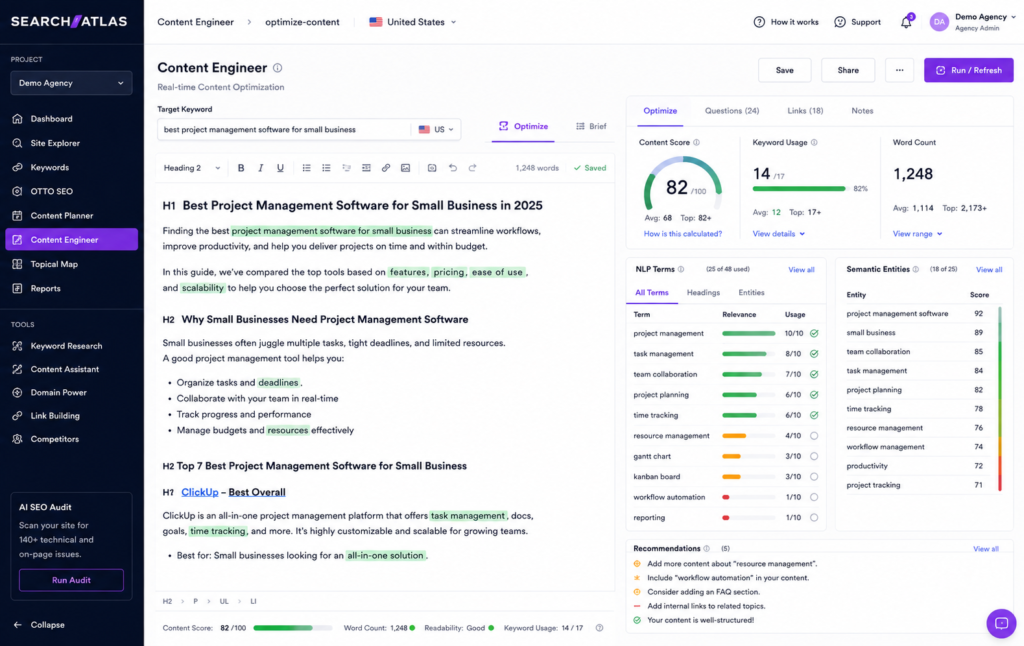
Search Atlas is designed for creators who want to build content that ranks well across both classic search pages and new conversational AI platforms.Overview
Search Atlas combines standard search data with an advanced, natural language processing content engine. Instead of simply matching basic keyword counts, the platform scans the top-ranking web pages to identify key semantic concepts, helping you structure articles that search engine algorithms understand and trust.
Key Features
- Advanced Content Engineer Canvas: Provides live, color-coded NLP grading that guides your writing as you compose your article.
- AI Search Engine Engine Visibility Tracker: Monitors your brand’s visibility across conversational platforms like ChatGPT search and Gemini.
- Automated Keyword Clustering: Uses semantic similarity matching to automatically sort long lists of target keywords into actionable topics.
Pros & Cons
Pros:
- Outstanding tool for optimizing text, removing fluff, and outperforming competitors on topical relevance.
- Intuitive on-page suggestions make it easy to hand clear instructions to freelance writers.
- Clean integration with WordPress and Google Docs interfaces.
Cons:
- Technical site auditing dashboards are less comprehensive than specialized deep-crawling platforms like Screaming Frog.
- Paid subscription tiers can feel expensive if you only need basic rank tracking features.
- Pricing: Starter plans open at $99/month, with their primary Growth plan priced at $199/month to unlock comprehensive multi-platform tracking features.
- Best For: Modern content creators, bloggers, affiliate marketers, and agency editors who focus on high-volume content production.
- My Recommendation: If your main channel for organic growth is publishing optimized articles and you want to ensure your content ranks well across both classic search and conversational engines, Search Atlas is an excellent fit.
- Overall Rating: ⭐⭐⭐⭐ (4.4 / 5)
Performance Comparison & Benchmark Insights
To give you an objective view of how these platforms perform side-by-side, here is an evaluation based on real-world agency tasks:
Evaluation Metrics
- Keyword Discovery Depth: The tool’s ability to uncover low-competition long-tail keywords along with accurate search volumes and intent metrics.
- Backlink Index Freshness: The time it takes for the platform’s web crawlers to discover and display a newly created inbound link.
- Geo-Targeting Accuracy: The precision of rank tracking data when verified against localized browser environments.
| Platform Name | Keyword Discovery | Backlink Freshness | Geo-Accuracy | Interface Complexity |
| Semrush One | Outstanding | Very Good | Very Good | High |
| Ahrefs | Very Good | Outstanding | Good | Moderate |
| SE Ranking | Good | Good | Very Good | Low |
| Nightwatch | Specialized | Moderate | Outstanding | Very Low |
| Search Atlas | Very Good | Moderate | Good | Moderate |
Real-World Use Cases & Deep Dive Workflows
To show you how these tools function in day-to-day business, let’s look at two practical workflows for launching digital projects.
1. Advanced Competitor Content Gap Analysis using Ahrefs
If you are running an educational website or expanding a digital footprint, outperforming established competitors requires identifying exactly where their search traffic comes from. Here is how to map those opportunities step-by-step:
- Step 1: Locate the Target SpaceLog into your Ahrefs dashboard and select the Competitive Analysis > Content Gap tool from the menu.
- Step 2: Input Your Competitor LandscapeIn the top text fields, enter the domain URLs of three leading competitors in your industry. In the bottom field labeled “But this website doesn’t rank for,” input your own website domain. Click Show Keywords.
- Step 3: Apply Dynamic Intersect FiltersThe tool will output thousands of keyword options. To find the highest-value opportunities, adjust the Intersection filter to focus on keywords where at least two competitors rank in the top 10. This filters out random anomalies and highlights core industry topics.
- Step 4: Sort by Search Intent and VolumeFilter the results by Search Intent to isolate informational terms (questions, guides) from transactional terms. Look for long-tail phrases with an accessible Keyword Difficulty (KD) score under 30 to secure fast rankings.
- Step 5: Export and Build Content BriefsExport your curated list as a CSV file. Pass these terms into your writing editor to build topical hubs that cover all your competitors’ hidden traffic sources.
2. Launching a Local Campaign and Syncing Data via SE Ranking
For brick-and-mortar storefronts or regional service operations, managing local citations and tracking precise regional search positions is vital. Here is the ideal workflow:
- Step 1: Initialize the Tracking CampaignOpen the SE Ranking dashboard, click Create Project, and input your business name and target domain.
- Step 2: Configure Precise Zip-Code LocationsUnder the search settings, select your target country, state, and specific city. Take it a step further by inputting the exact postal code or zip codes for your primary service areas to ensure high-accuracy tracking.
- Step 3: Connect Google Search Console and GA4Link your live Google Search Console profile under the integration settings. This pulls actual click and impression data directly into your tracking dashboard, providing a single source of truth for your performance.
- Step 4: Activate the Local Marketing ToolNavigate to the Local Marketing panel to sync your Google Business Profile listing. The tool will monitor your business review velocity, track photo uploads, and display your visibility changes across Google Maps results page grids.
- Step 5: Schedule White-Label Client ReportsSet up an automated monthly report using the drag-and-drop builder. Schedule the system to automatically email your team or clients a branded PDF highlighting local search visibility increases, keyword shifts, and click-through updates.
How to Choose the Right SEO Tool
Selecting the perfect platform depends heavily on your budget, team scale, and primary growth channels:
- Assess Your Main Growth Driver: If your strategy relies on digital PR, link outreach, and building domain authority, you will benefit most from a tool with strong link metrics like Ahrefs. If you rely on content volume, blogging, and on-page writing, optimization assistants like Search Atlas or Semrush are a better fit.
- Review User Constraints and Caps: Look closely at the fine print regarding project limits, user seat costs, and daily keyword tracking allowances. If you run a growing agency with multiple client sites, value-oriented suites like SE Ranking offer better flexibility than strict entry-level tiers.
- Verify AI Overviews and Modern Engine Data: Ensure the platform you choose includes native modules for tracking AI citations, Google AI Overviews, and conversational engines so you can measure your full search footprint.
Common Mistakes to Avoid When Using SEO Tools
- Chasing Vanity Metrics Over Conversions: Don’t focus solely on high search volumes. A highly competitive term like “marketing” might drive generic traffic, but a long-tail phrase with lower volume like “affordable B2B digital marketing software for small businesses” will attract warm, qualified leads.
- Relying Blindly on Keyword Difficulty (KD) Scores: Keyword difficulty ratings are automated estimates calculated by third-party systems. Always manually check the first page of search results to evaluate the actual search intent, structural layout, and quality of top-ranking pages before writing.
- Ignoring Regular Technical Site Audits: Publishing excellent content won’t help your rankings if search engine crawlers struggle to index your pages. Run a technical SEO audit once a month to catch broken links, slow pages, and structural errors early.
Frequently Asked Questions (FAQs)
1. What is the best SEO tool overall in 2026?
Semrush One remains the top all-in-one platform for broad competitive intelligence and marketing data. However, Ahrefs is preferred by advanced link builders, and SE Ranking stands out as the best choice for scaling agency budgets.
2. Can I do keyword research completely for free?
Yes. You can gather valuable first-party insights using free tools like Google Search Console (for your own site’s data), Google Autocomplete (for search intent discovery), and Google Keyword Planner (for basic local search volume estimates).
3. What is the difference between an LSI keyword and a long-tail keyword?
A long-tail keyword is a descriptive, multi-word search phrase with clear search intent (e.g., “how to track rankings in Google AI Overviews”). An LSI keyword is a semantically related term or concept (e.g., “natural language processing,” “search engine results pages”) that helps algorithms understand the topical context of your page.
4. Do I need to buy both Semrush and Ahrefs?
No. For the vast majority of content creators, freelancers, and small business owners, choosing just one comprehensive tool is more than enough to achieve great organic rankings.
5. Why are my search tool ranking positions slightly different from my real browser view?
SEO tools track positions using clean, neutral data nodes to show baseline rankings. Your personal browser view is adjusted by your location, search history, cookies, and account settings, which can skew individual results.
6. How often should I run a technical SEO audit on my site?
Running a comprehensive technical SEO audit once a month is ideal. This schedule helps you catch canonical errors, slow-loading pages, and broken links before they impact your organic rankings.
7. What is domain authority, and does Google use it directly?
Domain authority is a proprietary metric developed by third-party tools (like Moz or Ahrefs) to estimate how likely a site is to rank based on its backlink profile. Google does not use this metric directly in its algorithms, but it serves as a helpful benchmark for measuring your link building progress against competitors.
8. Which platform is best for handling local SEO client campaigns?
SE Ranking and Nightwatch are both excellent choices for local campaigns. Nightwatch excels at high-accuracy tracking across thousands of coordinate points, while SE Ranking provides comprehensive local listing tools and client reporting dashboards.
9. Can AI software handle all my SEO writing automatically?
While AI assistants can build fast drafts and organize structures, relying on unedited text often leads to generic content that lacks original insights. To build real authority and perform well in search, you should always edit AI content to add unique perspectives, data, and real-world experience.
10. How long does it take to see organic traffic results from new SEO efforts?
SEO is a long-term strategy. While technical adjustments or low-competition long-tail keywords can sometimes drive traffic within a few weeks, broader organic campaigns usually take 3 to 6 months to display clear ranking improvements.
Final Verdict & Affiliate Recommendations
Choosing the right search tool is about matching your specific marketing goals with the right data features:- The Best Overall & Premium Pick: If you want a comprehensive dashboard that handles search traffic tracking, deep competitor ad history, and detailed keyword research, select [Semrush One].
- The Authority & Link Builder’s Pick: If your primary growth channel is organic outreach, digital PR, and monitoring domain authority profiles, choose [Ahrefs].
- The Best Budget & Agency Alternative: If you need an affordable all-in-one suite that offers high usage limits, daily rank tracking, and clean client reports, select [SE Ranking].
Your Next Step: Stop guessing about your optimization strategy. Pick the tool that matches your current business goals, sign up for a trial account, and start running your first competitive audit today!